What an Austin water loss usually runs
These are planning ranges. They are what jobs of that shape typically run in this market, not a quote, and not a number anyone measured in your house. Use them to get oriented, then expect the real figure to come off a moisture meter.
- One room, clean water, caught the same day. Extraction, a few air movers and a dehumidifier for three days, baseboard off, readings morning and evening. Mitigation on a job like that commonly runs $1,200 to $3,500.
- Two or three rooms, carpet and pad out, drywall cut back. More equipment, more days, and a trailer load of material leaving the property: commonly $3,500 to $8,000 before a single sheet of new drywall goes up.
- Gray water from a dishwasher, a washer, or a tub overflow. The same footprint costs roughly a third to a half more than clean water, because porous material leaves the house instead of drying in place.
- A sewage backup. The most expensive water we handle per square foot, because almost nothing porous survives it and the removal, the protective equipment, and the disposal are all separate lines. Our sewage cleanup page covers what that work involves.
- Two floors, ceilings down, or a house that sat wet for days. Mitigation and reconstruction together land somewhere in the $15,000 to $40,000 band, and the rebuild is the larger half.
Measured per square foot of wet area, mitigation by itself tends to run about $3 to $5 for clean water, $5 to $7 for gray, and $7 to $10 for black. That per-foot figure is the honest way to compare two estimates. A grand total tells you almost nothing until you know how many square feet each company found wet.
The five things that decide your number
Five inputs build a water damage restoration cost estimate. Move any one of them and the total moves with it.
- What kind of water it was. Clean supply water is a drying job. Water that ran through an appliance or a trap carries contaminants, so porous material comes out and the crew works in protective gear. Clean water does not stay clean either: give it two warm days in a closed-up Austin house and it is Category 2, at Category 2 pricing.
- How much is wet, not how much looks wet. Water runs flat under a floating floor and climbs the bottom of the drywall. The band a meter finds is nearly always wider than the stain, and the band is what gets billed.
- How long it sat. The one input you control. Water pulled off the floor in the first hours is a dry-out. The same water found Monday morning is a tear-out, and often a mold job stacked on top of it.
- What has to come out. Baseboard and a foot of drywall is cheap. Cabinets, a glued-down engineered floor, soaked insulation, and tile set over a mortar bed are demolition, disposal, and a rebuild.
- How many days the equipment runs. Drying is not a flat fee, which is why the next section exists.
Drying is billed by the day, not by the job
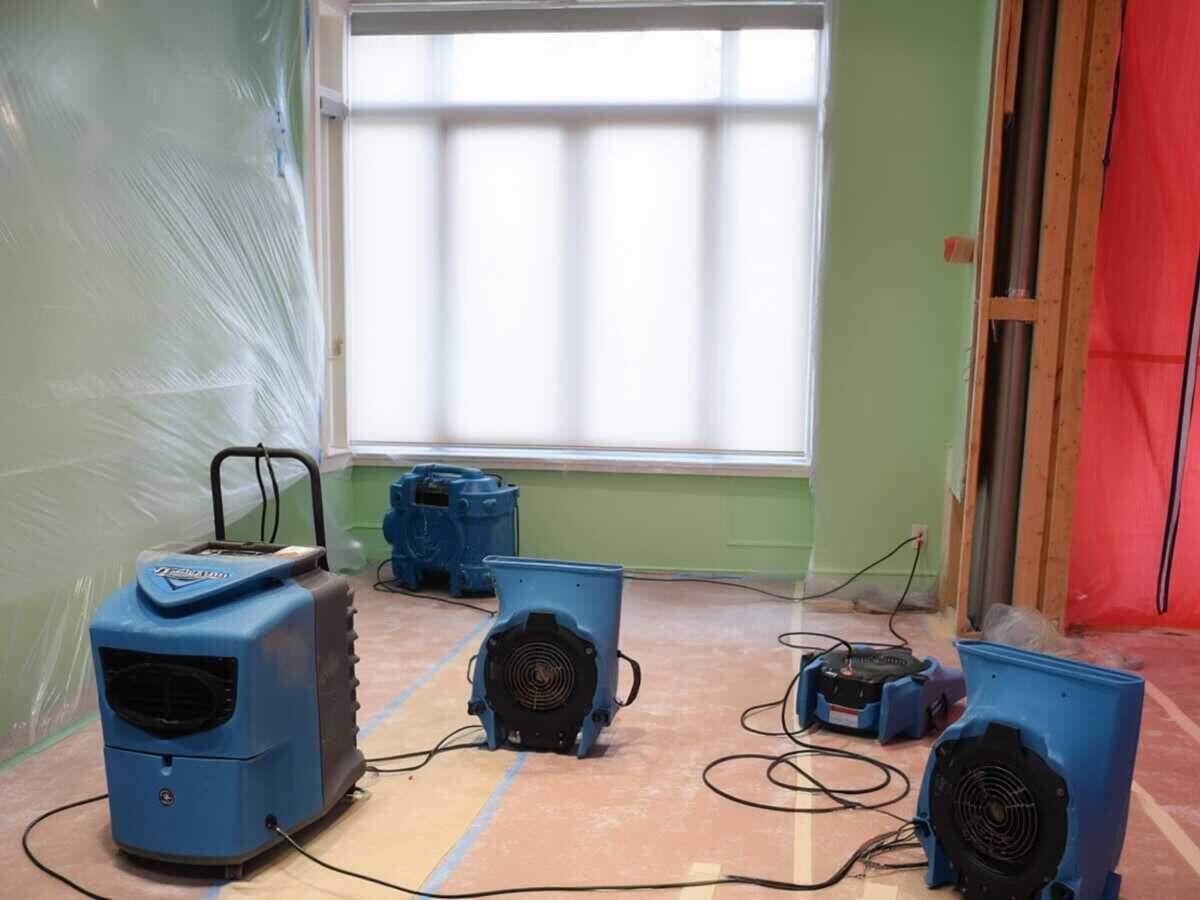
Mitigation is priced per piece of equipment per day, so "how long will this take" and "what will this cost" are the same question asked twice. On a typical price list an air mover sits in the $25 to $40 a day range and a dehumidifier several times that, with a HEPA scrubber close behind when the air needs filtering. Antimicrobial is applied and billed by the square foot. Four air movers and a dehumidifier for three days is a very different invoice from nine days of the same gear, and what makes the difference is dwell time and how much wet material stayed in the room.
Layout adds days too. Garage apartments and back-house rentals are ordinary now on the south and east sides of central Austin, and equipment does not carry across a driveway. A detached unit is its own drying chamber with its own dehumidifier and its own set of days, even when the wet area inside it is small. A second structure on the lot is a second setup, not a bigger one.
Most single-room jobs finish in three to five days of monitored drying. Our structural drying page walks through how the daily readings decide when the equipment comes out, which is the same decision that closes the equipment line on your bill.
Two invoices, not one: mitigation and reconstruction
Mitigation stops the loss. Reconstruction puts the room back. They are separate scopes, priced separately and often settled separately by an insurer, which is why a single phone quote for "the whole thing" is guesswork. The mitigation side is extraction, removal of what cannot be saved, drying, and the documentation. The reconstruction side is drywall, texture, paint, trim, flooring, and cabinets, and in this market that work tends to run about $20 to $40 a square foot of rebuilt area depending on the finishes going back in.
The order matters to your wallet. Dry fast and the reconstruction scope shrinks, sometimes to nothing. A swollen baseboard that dries flat stays on the wall. A solid hardwood floor that flattens under drying mats gets sanded and refinished instead of torn out. We write the mitigation scope on the first visit and the rebuild estimate after the structure reads dry, so what you approve is a repair list built on readings rather than a guess made on day one. Our water damage restoration page walks the full job from the first extraction to the last piece of trim.
What the common repairs run on their own
Most people arrive here with one room in mind, so here is the repair side broken out. Same caveat as above: typical ranges, not your number.
- Ceiling water damage repair cost: roughly $600 to $3,000 for one room. The spread is texture and insulation, not drywall. Matching sprayed knockdown across a whole ceiling plane routinely costs more than the board did. See ceiling water damage.
- Wall drywall: cut back two feet, replaced, taped, textured, and painted runs roughly $500 to $1,500 a room, depending on how many walls are involved and whether the paint can be feathered or the room has to be coated corner to corner.
- Water damage floor repair cost: carpet and pad about $3 to $7 a square foot installed, engineered plank $6 to $12, tile from $10 up. Refinishing a solid floor that dried flat costs a fraction of replacing it, which is the whole reason we dry floors in place whenever the meter allows.
- Cabinets and vanities: a swollen particle-board toe kick or cabinet base is replacement rather than repair, and matching a discontinued door front is what turns a small kitchen loss into a large one.
- The slab: there is no wet plywood subfloor to pull under most Austin first floors, because the floor is the slab. What replaces that line item is drying the concrete and reading it before new flooring is laid over the top.
Two jobs sit outside our lane, and a cost page should say so. Foundation water damage repair belongs to plumbing and foundation contractors: if a line under the slab has to be tunneled to or rerouted overhead, they price that work, and our side of it is the water that surfaced and spread through the house. Homes with a true lower level are also a small minority around here, so the ranges above assume a single slab floor. Our basement water damage page covers the exception.
Where mold changes the bill
Mold remediation cost is quoted apart from the water work, because it is a different scope with different equipment: containment, negative air, HEPA filtration, removal of whatever the growth is living in, and verification at the end. Typical mold removal cost by size in this market:
- One contained spot, a vanity bay or a section of wall behind a cabinet: commonly $600 to $1,800.
- A room under full containment, material out and the cavity dried: commonly $1,500 to $4,500.
- Several rooms, or growth that reached the air handler and ducts: $6,000 to $15,000 is a realistic band, and a whole-house job goes past it.
- Mold inspection cost, on the jobs where lab samples genuinely add something: usually $300 to $700, and independent clearance testing afterward lands in the same neighborhood.
Black mold removal cost runs above an ordinary cleanup, and the reason is worth knowing, because it is not the species. Nobody prices by what the lab calls it. The premium is the containment built to keep spores out of the rest of the house, the respirators and suits, and the third-party clearance at the end. The cheapest mold outcome by a wide margin is the one where the structure dried inside the first day or two and there is nothing to remediate at all. Our mold removal page covers how the containment side of that work runs.
Paying for it: deductible, direct billing, and payment plans
On a covered loss, most homeowners pay their deductible and the carrier pays the rest of the covered mitigation. Austin Flood & Leak Restoration bills most insurers directly for that part, so you are not fronting the cost of the drying while the claim is open. Hand us the claim number and your adjuster's contact once you have them and the documented scope goes to the carrier from us. What the policy does not cover still lands on you, and the two that catch people are long-term seepage and water that came into the house from outside. The insurance claims page goes through that in detail.
Homeowners ask us constantly whether water remediation companies have payment plans. Some do, some do not, and the honest answer depends on the size of the job, whether a claim is open, and who is doing the reconstruction. Ask before the equipment goes in rather than after, and you will get a straight answer in writing about what can be arranged and what cannot. If that is the question that matters most to you, call (512) 271-5099 and lead with it.
Why nobody can price your loss over the phone
An accurate number needs a meter, and the meter has to be in your house. Two kitchens that look identical from the doorway can differ by six thousand dollars, because one has water under the cabinet run and eight feet up a shared wall and the other does not. Any company that hands you a firm total off a phone description is either padding it heavily or planning to revise it once a crew is standing in your hallway.
What we can tell you on the phone is real enough to be useful: which tier the loss is probably in, what the first visit covers, how after-hours labor is billed, and what we would do first. What we will not do is invent a total. On site, a technician classifies the water, reads the structure, writes a line-item scope, and shows you the readings behind it before anything comes out of a wall.
Want the number instead of the range? Tell us what failed and how long it ran, and we will read the moisture on site and put the scope in writing before any material comes out.
Call (512) 271-5099Questions homeowners ask about cost
What does water damage restoration cost in Austin, on average?
There is no average worth quoting, because the spread is enormous and the middle of it describes nobody. A single wet room caught the same day usually runs $1,200 to $3,500 on the mitigation side. Several rooms with carpet, pad, and drywall out runs $3,500 to $8,000 before rebuild. A house that sat wet for days, or a sewage loss, goes into five figures once reconstruction is counted. Those are typical ranges for jobs of that shape, not a promise about yours.
Can you give me a price over the phone?
Not a real one, and we would rather say that than pretend. The price tracks the wet area a meter finds, and the meter has to be in the room. What we will tell you on the phone is which tier the loss is probably in, what the first visit includes, and how after-hours labor is billed, so you know roughly what you are walking into. The line-item scope comes from the on-site read.
Do water remediation companies have payment plans?
Some do and some do not, and it usually depends on the size of the job and whether an insurance claim is open. On a covered loss the question often disappears, because we bill the carrier directly for the covered mitigation and you are left with the deductible. If it is not a covered loss, ask us before the work starts. You will get an answer in writing about what can be arranged rather than a surprise conversation after the equipment is running.
Why is the mold work quoted separately from the water work?
Because it is a different scope. Drying a wet room needs air movers and a dehumidifier. Removing mold needs sealed containment, negative air pressure, HEPA filtration, protective equipment, and a verification step at the end, and none of that is included in a drying line. Mold remediation cost lands between a few hundred dollars for one contained spot and five figures for a house with growth in the ducts. It is also the cost most often avoided outright, by drying the structure before growth ever starts.
What does the first visit cost?
We tell you what the first visit costs and exactly what it includes before a truck leaves, so nothing about it is a surprise on the invoice. That visit is where a technician classifies the water, meters the walls, subfloor, and framing, maps how far the water traveled, and writes the documented scope your insurer will work from. Call (512) 271-5099 at any hour and ask, or use the contact page, and you will get the terms up front rather than after the fact.