Structural Drying & Dehumidification in Austin, TX
The plumber left at noon and the wall behind the baseboard is still full of water. Mopping got the floor; nothing got the framing. We size air movers and dehumidifiers to the room and log a reading every day until the framing reads dry.
- We bill your insurer directly
- IICRC-certified crews
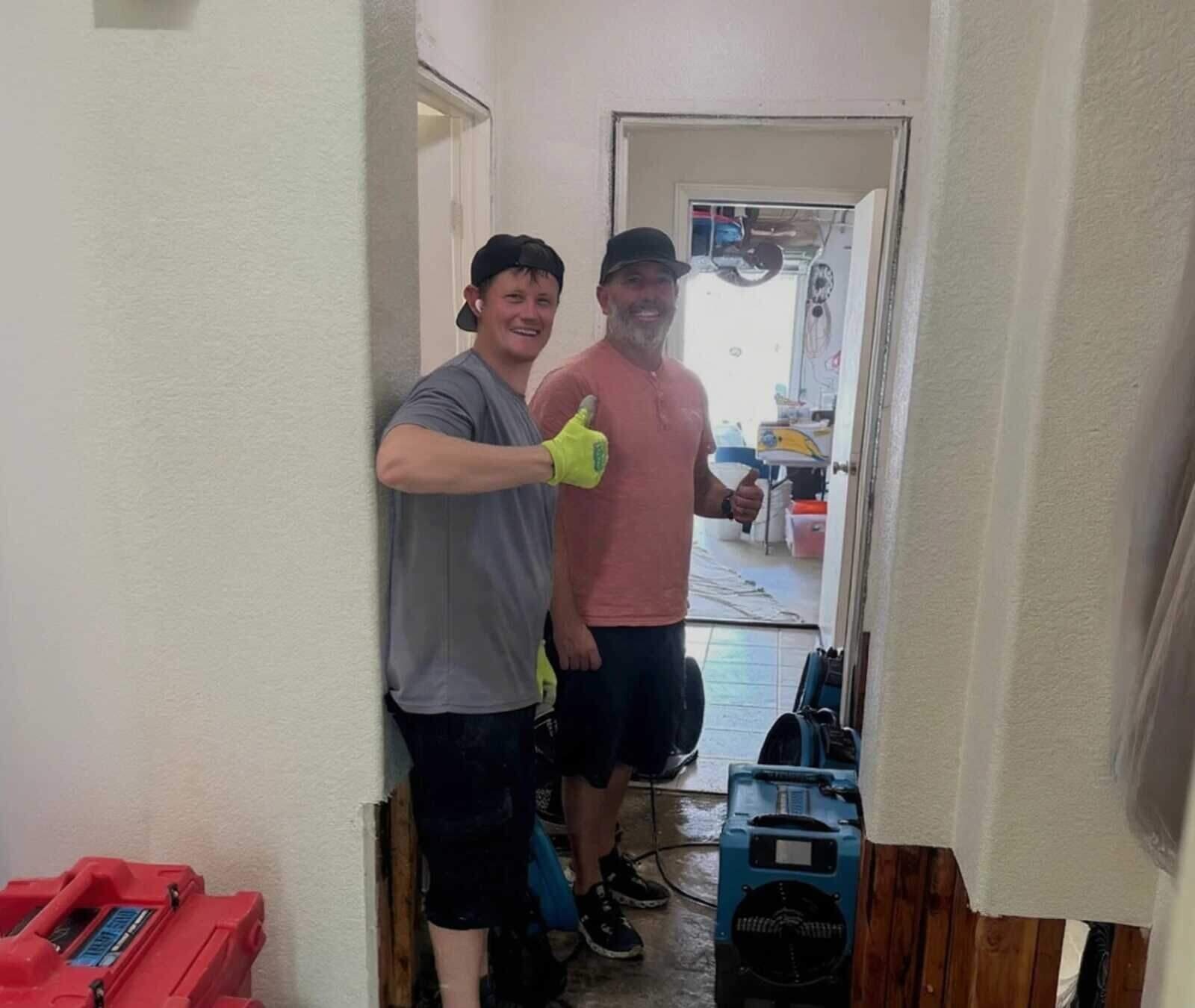
A local crew that shows up and does it right




The water that stays behind after the floor looks fine
Extraction takes the water that will still move on its own. What is left has soaked into materials, and every material gives it back on a different schedule. These three set the length of the job.
Framing and subfloor
Studs, bottom plates, and plywood hold water deep in the grain and release it over days. They are usually the last readings to come down, and the reason equipment stays as long as it does.
Drywall, base and batts
Gypsum wicks water up from the floor well past the line you can see, and an insulation batt behind it will not dry through the board. The gypsum usually dries in place. The soaked batt comes out.
Slab and what is glued to it
Concrete stores moisture and hands it back into the room long after the surface is dry, and glued flooring pins it against the slab where no airflow reaches.
How much equipment a room actually takes
Machines get sized off the room and the readings, not off whatever is left in the van. The arithmetic comes first:
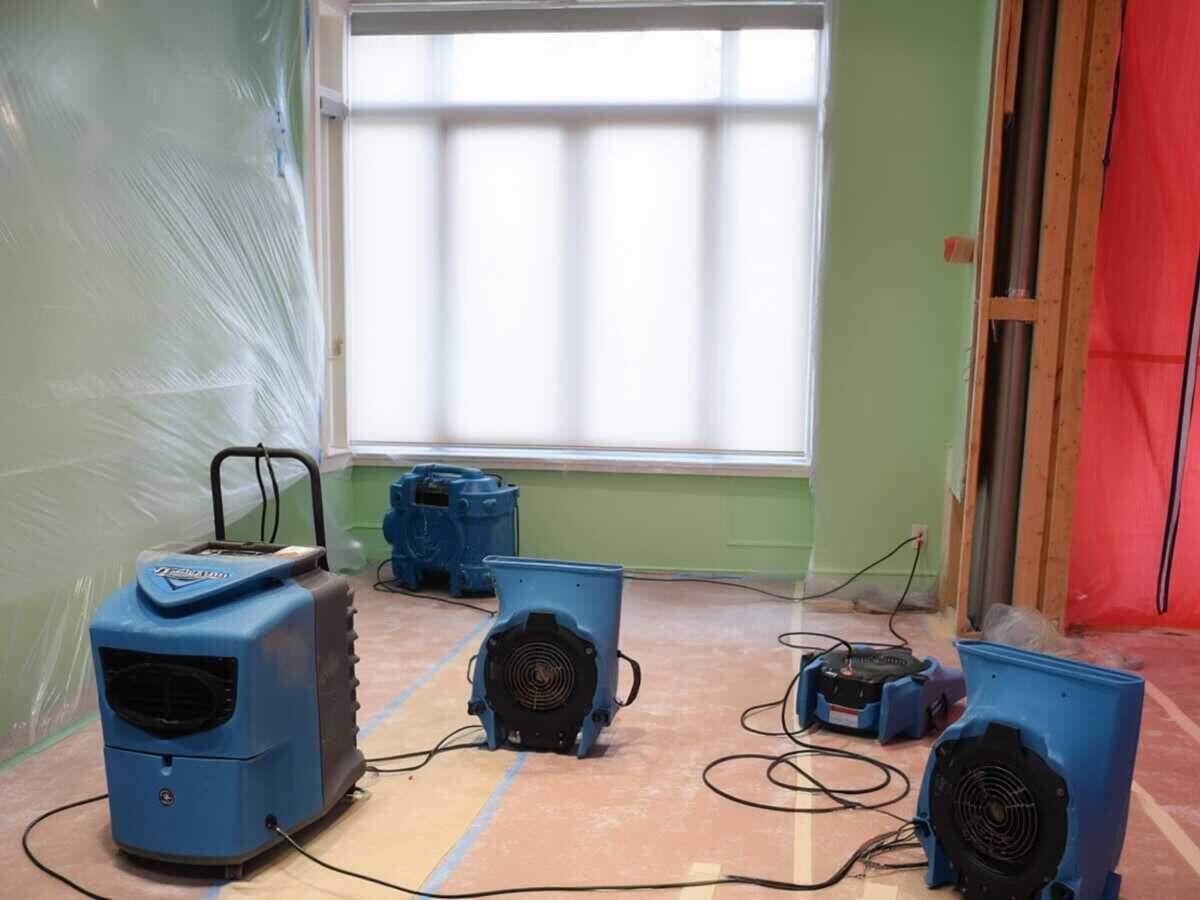
- Air movers counted by wall, not by room. Roughly one machine for every ten to sixteen feet of wet wall, set at a shallow angle so it peels the damp layer of air off the surface instead of stirring the middle of the room.
- Dehumidifiers matched to volume. A low-grain refrigerant unit is rated in pints per day and picked against the cubic feet inside the containment and how much of the room drank water. Desiccants come out for cold spaces and very low targets.
- Moisture meters that read materials, not air. Pins into wood and gypsum, a pinless scan across a floor, a hygrometer at the dehumidifier intake and exhaust, and infrared to find the edge of a wet area behind a finish.
- Containment around the wet zone. Sheeting the area off is what puts the dehumidifier to work on your soaked wall rather than on the humidity of the whole house.
Every decision has a number behind it
The plan is set on the first visit and edited every day after, off readings taken in the same spots, by the same crew, with the same meter.
Set the Baseline
Wet materials read and marked room by room, plus a dry reference somewhere the water never went. That reference is the number we are drying back to.
Build the Zone
Containment up, machines placed to the readings, and the load split across circuits so a breaker does not quietly end the night.
Adjust on the Numbers
Readings logged daily by location. Equipment moves, comes out, or gets added as the wet map shrinks.
Prove It, Then Pull Out
When the wet materials hold the reference number, the equipment leaves and the log goes to your adjuster with it.
What we are removing, and how we know it is gone
Structural drying is the stage where the water that soaked into a house comes back out of it under conditions we control. Air movers lift moisture off the surface of the material, dehumidifiers pull it out of the air so the room can keep accepting more, and a meter says when to stop. Everything else here is detail underneath those three jobs. It is also the stage homeowners are most often overcharged for, because equipment on a floor looks like progress whether or not anybody is reading it.
Sizing, wiring, and an Austin August
The math is not complicated and the mistakes are always in the same two places. Too few air movers and the surfaces give up their water slower than the dehumidifier could take it, so the job runs a week and the invoice grows. Too many machines in a sealed room, with a dehumidifier that cannot keep up, and all that moving air simply carries the moisture into dry framing next door. What keeps the balance honest is the hygrometer at the dehumidifier: air going in should read wetter than air coming out, and when the gap closes, the room is either dry or the machine is undersized for it.
Then there is the wiring, which no equipment chart mentions. A dehumidifier plus four air movers pulls more than a single fifteen-amp branch circuit will carry, and in the 1950s and 60s ranch stock around Brentwood and Barton Hills one circuit can serve half the house. We split the load, run a cord to a laundry or garage outlet where we have to, and walk the panel before leaving, because a breaker that trips at midnight costs a full day of drying that nobody discovers until morning. August adds the other local problem: every machine in that room is also a heater, the outdoor air is sitting at a seventy-degree dew point, and opening a window to help undoes the day. The air conditioning stays on and the zone stays closed.
When a wall or a floor has to be opened
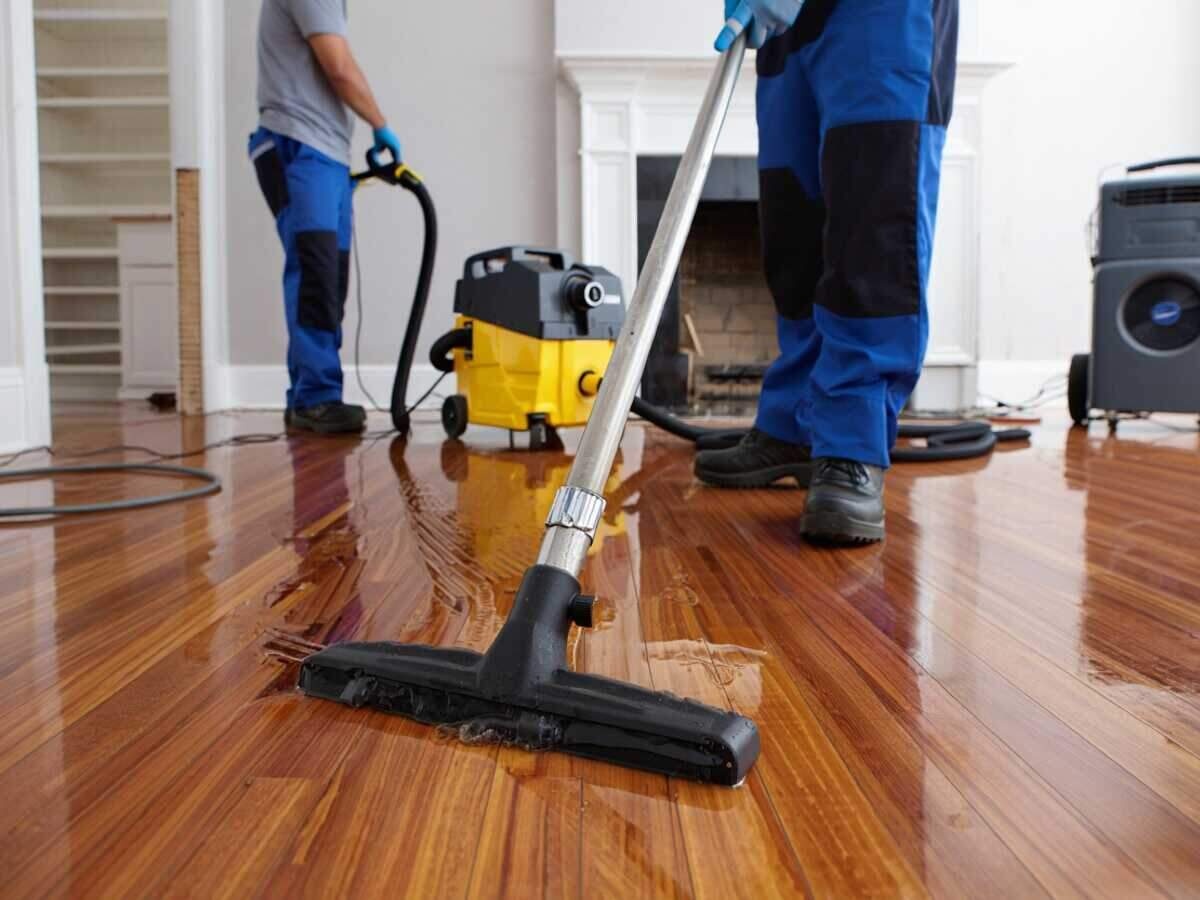
Austin Flood & Leak Restoration opens as little as the readings allow, and we would rather drill a hole than cut a sheet. Baseboard comes off and small holes go into the cavity behind where it will sit again, then air gets injected into the wall so the framing dries without the drywall coming down. That works while the insulation is dry. A soaked fiberglass batt does not dry through a sheet of gypsum at any speed, so where insulation took water the board comes off, usually to two feet, and the cavity dries open. Exterior walls across most of this metro are brick veneer over stud, which means a wet cavity cannot dry outward through the masonry and has to be worked entirely from the room side. Wood floors follow different rules and different gear, mats sealed to the surface with a vacuum pulling through the boards, and that half of the work is on our hardwood floor water damage page.
The log is what you are actually buying
Any water damage drying company can leave four machines in a room for five days and hand you an invoice. What should come with it is the moisture mapping from day one and a reading for every wet location, by date, showing what was wet, how fast it came down, and what it read the morning the equipment left. That record is also the difference between an adjuster paying for six days of drying services and questioning why the equipment was there past day three. We document the loss and hand the file over; your carrier decides what the policy covers, and the insurance claims page explains how that runs in Texas. Drying starts on the same visit the standing water comes off the floor, which is the water removal half of the same trip, and the full sequence through to rebuild sits on the water damage restoration page. Call (512) 271-5099 at any hour.
Frequently asked questions
Can I rent a dehumidifier and do this myself?
For a cup of clean water on tile, caught in minutes, a rental dehumidifier and a fan are genuinely enough. What a rental cannot do is tell you the wall cavity is dry. Every serious decision in drying comes off a reading, and the machines you can rent for water damage are sized for a damp garage rather than for a room where the bottom plate is soaked. If the water reached carpet, drywall, or anything wood, get a meter on it before you commit to a week of equipment noise that may be aimed at the wrong wall.
How many days will the equipment run?
Three to five days covers most clean-water losses caught the same day. Longer where water sat under tile, soaked into a slab, or reached hardwood, and longer again if the loss went unnoticed for a weekend. Nobody honest can give you the number on the phone, because it depends on how much material took water and how deep. What we can promise is that the days are decided by the readings and not by a schedule: when the wet materials match the dry reference, the machines leave, whether that is day three or day eight.
The fans are loud. Can we shut them off at night?
Please do not, and here is the trade you are making. Air movers and the dehumidifier work as a pair, and a room left closed and still overnight lets the air go humid again and the surfaces reabsorb what came out of them that day. Eight quiet hours usually costs a full day on the back end. What we can do is move machines out of bedrooms once those readings are down, aim them away from doorways, and tell you which rooms you can close off. Most families end up sleeping at the far end of the house for a few nights.
What does all that equipment do to my power bill?
A dehumidifier draws roughly what a window air conditioner does, and each air mover about what a box fan does, running around the clock for the length of the job. On a typical setup you would notice it on the bill without it changing your month. We log the run hours per machine because it is part of the drying record, and some carriers include a utility allowance in the claim while others do not, so it is worth asking your adjuster directly. Turning the equipment off to save on power costs more in drying days than it saves in kilowatt hours.
How do you decide the house is dry?
By comparison, never by feel. On the first visit we read every wet material and also a dry reference: the same kind of material, in a room the water never reached, in the same house on the same day. That reference is the target, since a number that means dry in a February house means something different in August. The job is finished when the affected materials sit at the reference and hold it on the next day's reading. Those final numbers go in the file with the dated photos, which is what proves the structure was dried rather than just left to sit under fans.
Documented to claim standard from the first hour
We document the loss to claim standard from the moment we arrive: dated photos, moisture readings by room, and a line-item scope that maps to your policy. Then we bill your insurer directly for the covered work, so you handle the deductible.
See how claims work in TexasAreas We Serve Across the Austin Metro
Local response across Travis, Williamson, and Hays counties.
Wet framing does not fix itself
Describe what got wet and when. A technician here will walk you through what a loss like yours usually reads on day one and what the drying is likely to take. Call (512) 271-5099 any hour, and ask the crew for the daily log when they arrive: it is the part of this job you can check for yourself.